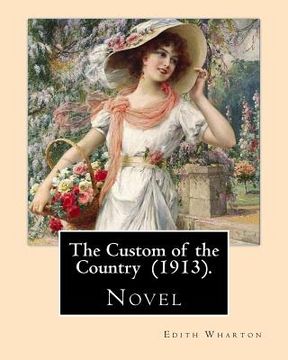
The Custom of the Country (1913). By: Edith Wharton: Novel. It tells the story of Undine Spragg, a Midwestern girl who attempts to ascend in New York (en Inglés)
Reseña del libro "The Custom of the Country (1913). By: Edith Wharton: Novel. It tells the story of Undine Spragg, a Midwestern girl who attempts to ascend in New York (en Inglés)"
The Custom of the Country is a 1913 novel by Edith Wharton. It tells the story of Undine Spragg, a Midwestern girl who attempts to ascend in New York City society.The Spraggs, a family of midwesterners from the fictional city of Apex who have made money through somewhat shady financial dealings, arrive in New York City at the prompting of their beautiful, ambitious, but socially-naive daughter, Undine. She marries Ralph Marvell, a member of an old New York family that no longer enjoys significant wealth. Before her wedding, Undine encounters an acquaintance from Apex named Elmer Moffatt, a character with "a genuine disdain for religious piety and social cant", as the scholar Elaine Showalter observes. Undine begs him not to do anything that will endanger her wedding to Ralph. Elmer agrees. Although Ralph dotes on Undine, his finances do not permit the extravagant lifestyle Undine desires, and she feels that her in-laws scorn her. When she becomes pregnant, she is disconsolate; and she neglects her son, Paul, after he is born. Alone in Europe, Undine begins an affair with the nouveau riche Peter Van Degen, who is married to Ralph's cousin, Clare. She then divorces Ralph in the hope of marrying Peter, but this does not work out: Peter seems to want nothing more to do with Undine, and Clare will not grant him a divorce anyway. As a divorcee, Undine loses her high position in society, and spends a few years living in North Dakota, New York, and Paris, scheming to scramble up the social ladder again. In Paris, a French count, Raymond de Chelles, falls in love with Undine. They desire to get married, but, as a Catholic, Raymond cannot marry a divorcée. To procure enough money to bribe the Pope to annul Undine's previous marriage, Undine blackmails Ralph. Having been awarded custody of their son, but allowing him to live with Ralph (it was inconvenient for her to raise him in Europe), she demands that the boy be sent to her. It is clear that she will let him remain with Ralph only if he sends her a large sum of money. Ralph does not have sufficient funds of his own, so he borrows money from friends and family and invests it in one of Elmer Moffatt's business deals. The deal does not go through in time to meet Undine's deadline, and Moffat also informs Ralph that he had once eloped with Undine and then was divorced from her-the secret she feared that New York society would discover. Shocked, and also distraught at the thought of losing his son, Ralph commits suicide. Undine is able to marry Raymond as a widow, though this would not be possible if Raymond knew of her first marriage to Moffat. Undine is soon dissatisfied with Raymond, too. The de Chelles are hidebound aristocrats, their wealth tied up in land and art and antiques that they will not consider selling, and Undine cannot adjust to the staid customs of upper-class French society. She also resents having to spend most of her time in the country because her husband cannot pay for expensive stays, entertainment, and shopping trips in Paris. Ultimately, she divorces Raymond in order to remarry Elmer Moffatt, who by now has made a fortune. Now, married to the crass midwestern businessman who was best suited to her in the first place, Undine finally has everything she ever desired. Still, it is clear that she wants even more: in the last paragraph of the novel, she imagines what it would be like to be an ambassador's wife - a position closed to her owing to her divorces.... Edith Wharton ( born Edith Newbold Jones; January 24, 1862 - August 11, 1937) was a Pulitzer Prize-winning American novelist, short story writer, and designer. She was nominated for the Nobel Prize in Literature in 1927, 1928 and 1930.Wharton combined her insider's view of America's privileged classes with a brilliant, natural wit to write humorous, incisive novels and short stories of social and psychological insight.
Edith Wharton (Nueva York, 24 de enero de 1862 – Saint-Brice-sous-Forêt, 11 de agosto de 1937) fue una novelista, ensayista y diseñadora estadounidense reconocida internacionalmente por su estilo refinado y su mirada crítica hacia las normas sociales de su tiempo. Procedente de una de las familias más acomodadas de Nueva York y formada en un entorno cosmopolita que incluyó largas estancias en Europa, desarrolló desde joven un interés especial por la literatura, la arquitectura y el arte, lo que nutrió profundamente su obra.
A finales del siglo XIX debutó en el ámbito literario con relatos y con la publicación de The Decoration of Houses (1897), un influyente ensayo sobre diseño de interiores escrito junto a Ogden Codman Jr. Su reconocimiento como novelista llegó con títulos como La casa de la alegría (1905) y Ethan Frome (1911), en los que retrató con gran sensibilidad las ambiciones, restricciones y contradicciones de la alta sociedad estadounidense.
El éxito definitivo de su carrera se consolidó en 1920 con La edad de la inocencia, novela que le valió el Premio Pulitzer en 1921, convirtiéndose en la primera mujer en recibir este galardón. A lo largo de su vida publicó más de 40 libros, entre novelas, ensayos y relatos, caracterizados por su ironía, elegancia estilística y penetrante visión social.
Instalada en Francia tras su separación de Edward Wharton, combinó la creación literaria con un compromiso activo en obras humanitarias durante la Primera Guerra Mundial. Sus últimos años los dedicó a seguir escribiendo y a cultivar su pasión por los jardines y el diseño arquitectónico en residencias como “The Mount”.
Su obra, traducida a numerosos idiomas y aún vigente, ha sido estudiada por su aporte al realismo literario moderno y por su capacidad para iluminar las tensiones entre el deseo individual y las convenciones sociales, manteniéndola como una de las autoras más influyentes de la literatura universal.
Ver más
Ver menos